
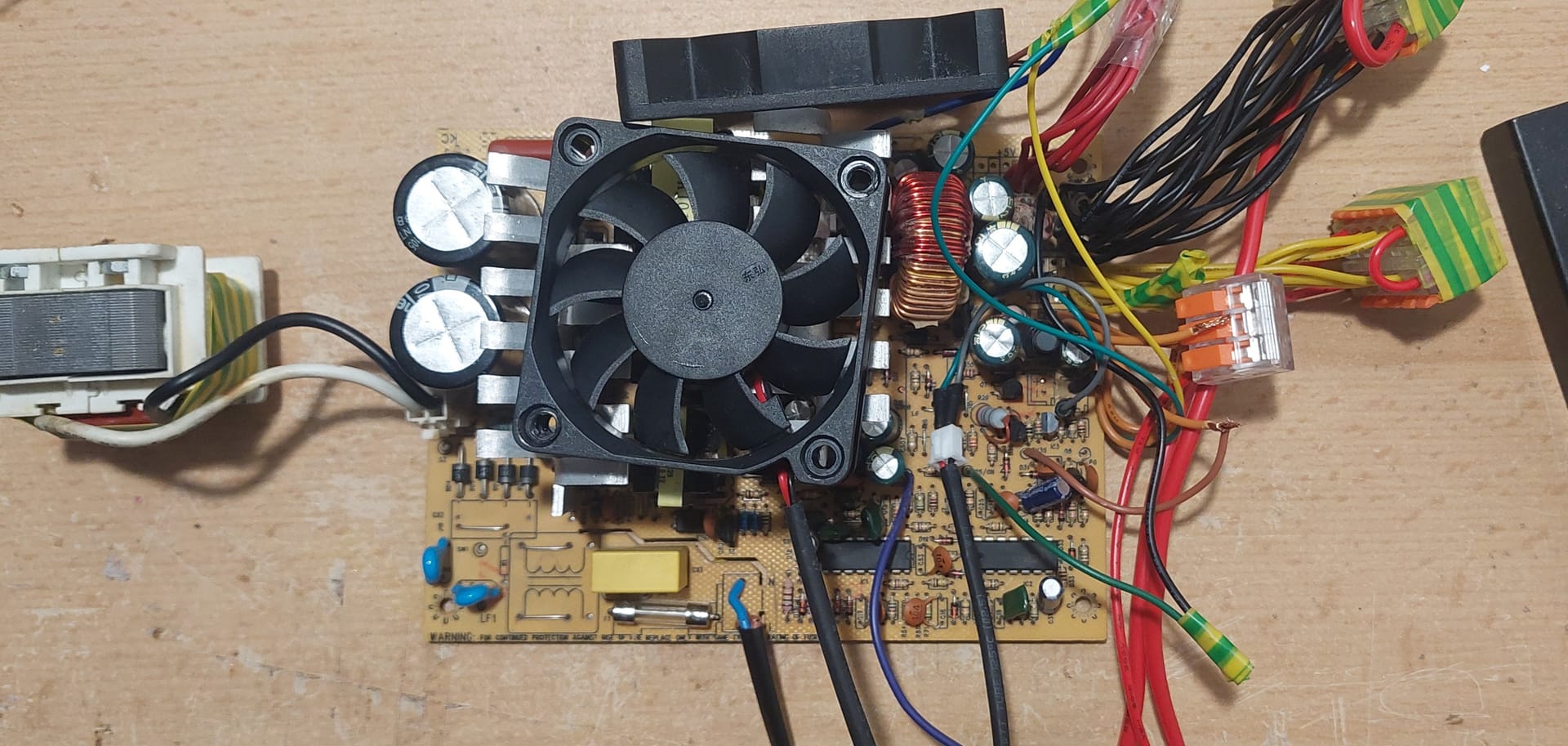
Around a month ago, I found the power supply from my dad's old computer, the remains of which, are unfortunately not with us anymore. Other than a few broken ATA drives (not physically, but data and control board wise, completely unusable), the remains of CPU pins (it was an AMD system) and that power supply, nothing else was found.
Speaking of the power supply, it was found in a state of wires cut right off it (the ketchup 'n mustard kind), no chassis - so no electrical ground and a lot of components not soldered. For all I know, my younger self (around 5 years old) found this PSU and decided to go to town on it! Now, messing around with power supplies, especially the old ones with a lot of old practices, is already super dangerous. Doing it as a 5 year old, with (probably) non-isolated tools? Even worse. I mean, even the new ones can mess you up if you abuse them enough.
Restoration
Unlike the YouTube restoration channels, I didn't coat it in a layer of rust to make the finished product look more impressive. I picked up my soldering iron and gosh dang it, I made very short work of it. By literally shorting a few joints together.
I cleaned up my iron tip, applied a clinically insane amount of flux everywhere and actually fixed practically all of the solder joints. I say practically due to the fact that my 60W iron is just not powerful enough to heat up the copper fills of that board, so while there may be a few cold joints here and there, the damn thing works!
Voltage woes
As per the ATX PSU specification, I compared my voltage measurements to whatever they classify as safe and reasonable. Boy oh boy was I not ready for this one.
Supply voltage
| Voltage | ATX spec. | My readings |
|---|---|---|
| +12V | +11.40V to +12.60V | +14.24V |
| -12V | −10.80V to −13.20V | -13.29V |
| +5V | +4.75V to +5.25V | +5.89V |
| +5VSB | +4.75V to +5.25V | +5.35V |
| -5V | −4.50V to −5.50V | N/A |
| +3V3 | +3.135V to +3.465V | 0V |
Measured with a calibrated DMM with the correct polarization.
You might have noticed -5V being N/A. This is because the PSU doesn't actually have a -5V rail. Next up, +3V3 being 0V? That's right. This PSU says it can do 3.3V at 22A, it even has several wires with the 3V3 color coming out of it, yet there's 0V on those wires. I wouldn't immediately blame the PSU for this, as it's quite possible my, let's be real here, shitty solder job probably caused this. I'll leave those two rows out in the next tables.
This is already enough of a reason for anyone sane to stop using this PSU immediately, as just owning it in this state could be a bomb hazard in multiple states. These voltage readings are already quite bad, but wait for what's about to come up.
Voltage drop on 5A load
| Power rail | ATX spec.* | My readings |
|---|---|---|
| +12V | 0.6V | 1.6V |
| -12V | 0.12V | 1.1V** |
| +5V | 0.25V | 0.61V |
| +5VSB | 0.25V | 5.2V** |
Measured with a calibrated DMM with the correct polarization. A resistor was used to simulate a load.
* There is no real ATX spec for this, so I assumed a ±10% tolerance for -12V and a ±5% for the rest.
** -12V and +5VSB don't support 5A, hence 0.5A and 2.5A was used respectively.
Notice another strange thing? The +5VSB rail drops to basically nothing under a 2.5A** load. My guess is the over current protection is too aggressive and trips the moment I reach the rated maximum current.
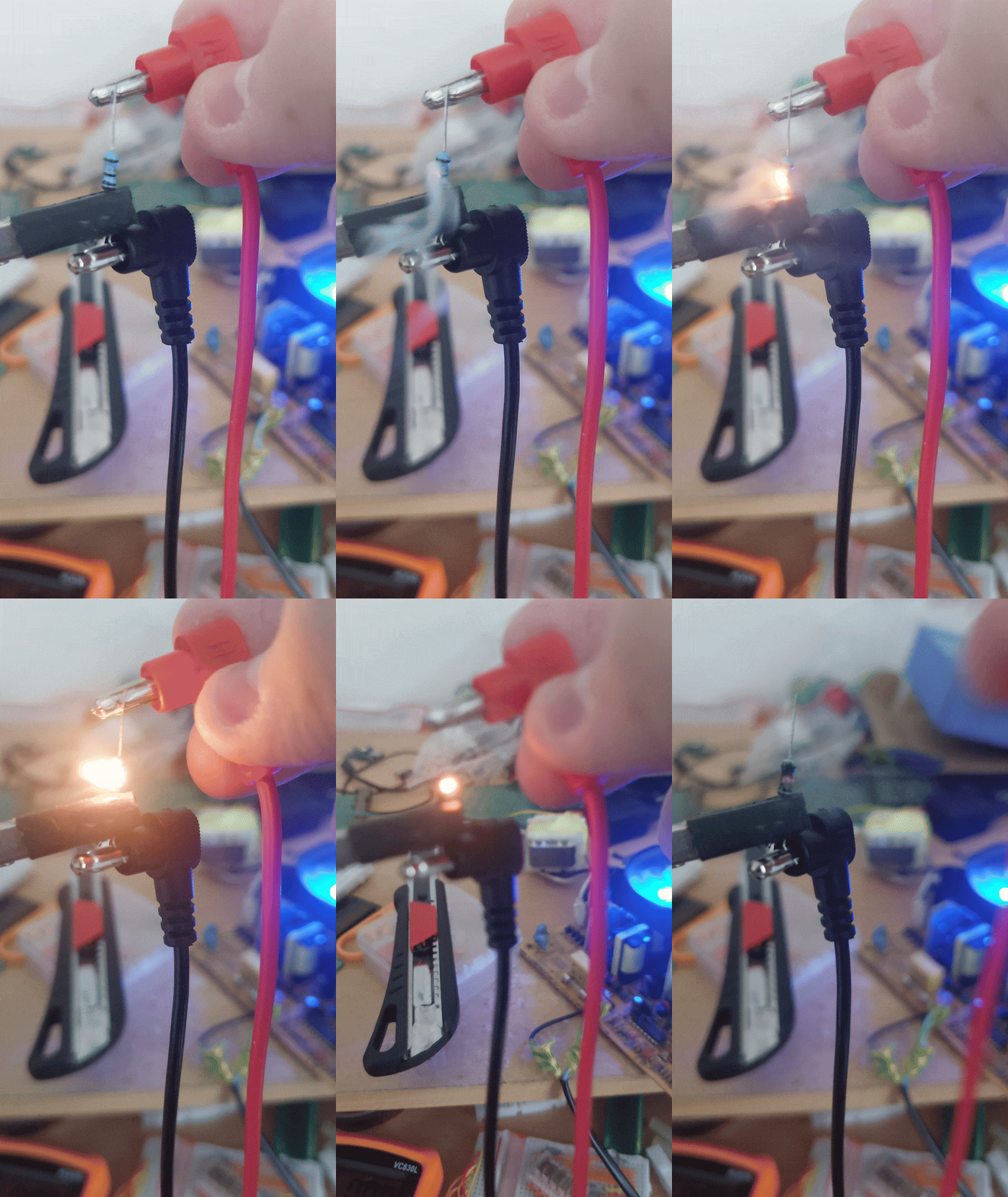
I would show the voltage ripple next, however I don't have the proper equipment to measure it and I'd hate to give out inaccurate data. I also attempted to do a maximum load test, however in the process I burned out far too many resistors. 😆
This PSU seriously has the capabilities to reduce a 10Ω resistor into flames. Albeit that should be pretty much the standard nowadays.
That would be all from me. ✌️